
Sirolimus (Rapamycin)
Sirolimus, also called rapamycin, is a prescription medication that is FDA approved to help prevent organ transplant rejection and to treat lymphangioleiomyomatosis. It is not FDA approved for aging or longevity. A licensed provider decides if it is appropriate for you.
Compounded drugs are not FDA approved. FDA does not review compounded drugs for safety, effectiveness, or quality before marketing.

See it before your first visit
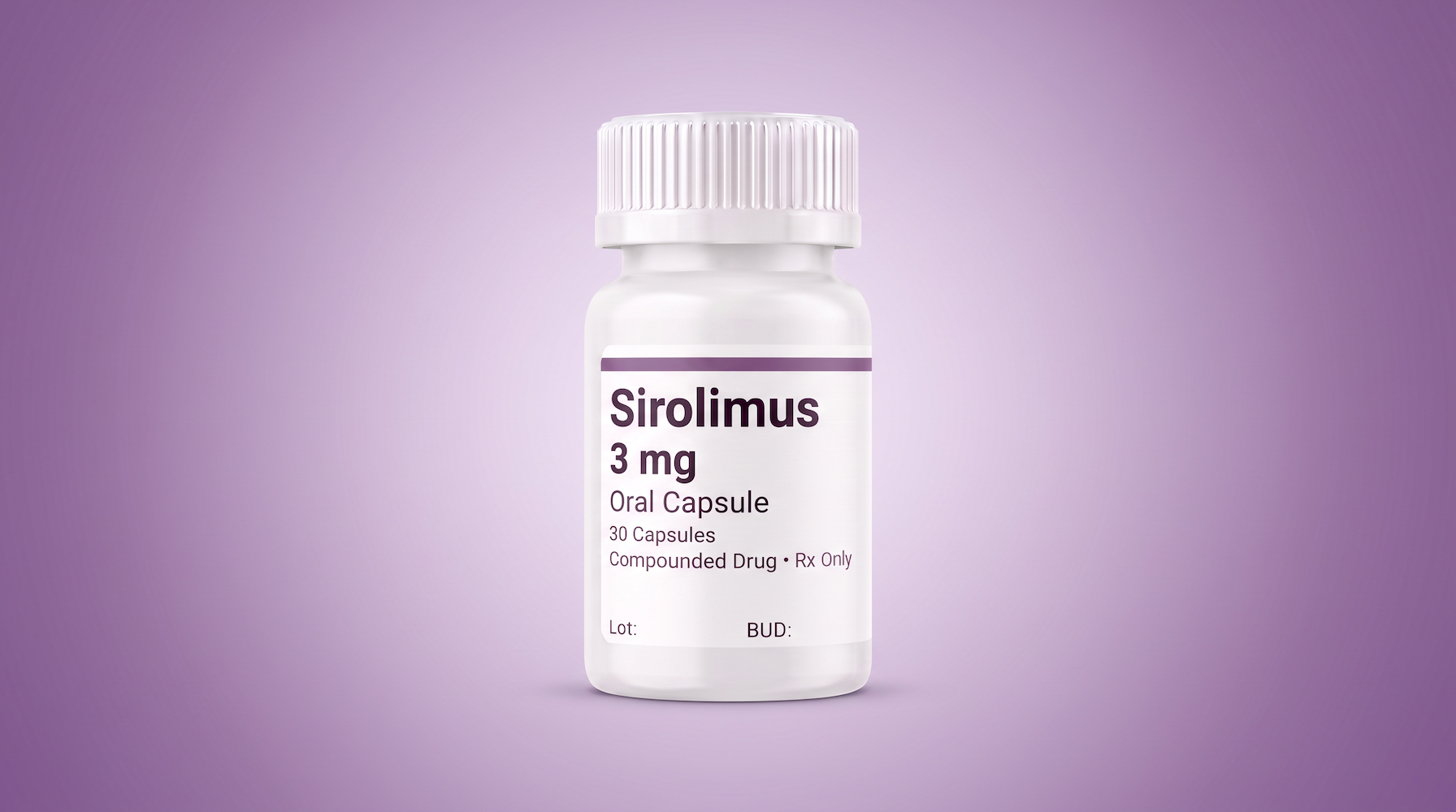
Photographs of the medication as dispensed.


What it is
Sirolimus, also known as rapamycin, is a prescription medication that blocks a protein called mTOR. The FDA has approved sirolimus to help prevent organ rejection in people who have received a kidney transplant, and to treat lymphangioleiomyomatosis (LAM), a rare lung disease.
Sirolimus is not FDA approved for aging, longevity, or healthspan. Research into its effects on aging has been done mostly in laboratory and animal studies, and a limited number of small human studies. It has not been shown in large, well-controlled human trials to slow aging or extend lifespan.
Some licensed providers prescribe sirolimus as part of a longevity program after an evaluation, based on their clinical judgment. This is a decision made for each patient, and it is not right for everyone. Sirolimus suppresses the immune system and carries serious warnings.
How it works
Sirolimus blocks mTOR, a protein that helps control cell growth, metabolism, and immune responses. In transplant medicine, this lowers the activity of immune cells that can attack a transplanted organ. Because mTOR is involved in many body processes, sirolimus can also affect blood sugar, cholesterol, healing, and infection risk. Your provider can explain what is and is not known about its effects and risks for you.
What to expect
Your provider will review your health history, medications, vaccination status, and lab work before prescribing, and will explain the dose, schedule, and what to watch for. Treatment usually includes baseline and follow-up blood tests, which may check cholesterol, triglycerides, blood sugar, kidney function, liver function, and blood counts.
Because evidence for use in aging is limited, no outcome can be promised. Individual responses vary, and results are not guaranteed.
Who it is for
Whether sirolimus is appropriate for you is a decision made by a licensed provider based on your health history, medications, and lab results. It is not appropriate for everyone.
Tell your provider if you have an infection, a history of cancer, diabetes, high cholesterol or triglycerides, kidney or liver disease, lung disease, or slow wound healing, if you plan to have surgery or vaccines, or if you are pregnant, planning to become pregnant, or breastfeeding. Share every medication, supplement, and food you use, because many interact with sirolimus.
This page is general information and is not medical advice.
Side effects
Commonly reported side effects include mouth sores, high cholesterol and triglycerides, high blood sugar, swelling, acne, headache, diarrhea, nausea, joint pain, and low blood counts such as anemia and low platelets.
Serious risks include infections, some cancers including lymphoma and skin cancer, slowed wound healing, kidney problems, protein in the urine, lung inflammation (interstitial lung disease), and allergic reactions including angioedema. Seek urgent care for fever, chills, a cough that does not go away, shortness of breath, swelling of the face or throat, or signs of a serious infection.
Read this before you start
Compounded drugs are not FDA approved. FDA does not review compounded drugs for safety, effectiveness, or quality before marketing.
Medication availability, formulation, packaging and pharmacy fulfillment vary based on the patient's prescription and location.
FDA status. Sirolimus is FDA approved to help prevent organ rejection in kidney transplant recipients and to treat lymphangioleiomyomatosis. It is not FDA approved for aging, longevity, or healthspan. Any use for those purposes is a prescriber's clinical decision.
Boxed warning, immunosuppression. Sirolimus can weaken the immune system, which increases the risk of serious infections and of cancers such as lymphoma and skin cancer. Only providers experienced in managing immunosuppressive medications should prescribe it.
Boxed warnings, transplant use. In liver transplant, sirolimus has been linked to excess deaths, graft loss, and hepatic artery thrombosis, and in lung transplant, to bronchial anastomotic dehiscence. It is not recommended in these settings.
Vaccines. Avoid live vaccines while taking sirolimus unless your provider says otherwise. Tell any provider who treats you that you take it.
Medication and food interactions. Many drugs, including certain antifungals, antibiotics, and seizure medications, and grapefruit juice can change sirolimus levels. Do not start or stop anything without checking with your provider or pharmacist.
Metabolic effects. Sirolimus can raise cholesterol, triglycerides, and blood sugar. Your provider should monitor lab work.
Surgery and wound healing. Sirolimus can slow wound healing. Tell your surgeon and provider before any procedure.
Pregnancy and fertility. Do not use sirolimus if you are pregnant or planning to become pregnant. Talk to your provider about effective contraception and about fertility effects.
Sun exposure. Limit sun and UV exposure, and use protective clothing and sunscreen, because of skin cancer risk.
Not medical advice. The information on this page is general and educational. It does not establish a provider relationship and does not replace a consultation with a licensed provider.
Common questions
Is sirolimus FDA approved?
Yes, for specific uses. The FDA has approved sirolimus to help prevent organ rejection in kidney transplant recipients and to treat lymphangioleiomyomatosis (LAM). It is not FDA approved for aging or longevity.
Is sirolimus the same as rapamycin?
Yes. Rapamycin is another name for sirolimus.
Does sirolimus slow aging?
That has not been shown in people. Research on aging has been mostly in laboratory and animal studies plus limited small human studies. No outcome can be promised.
Do I need a prescription for sirolimus?
Yes. A licensed provider must evaluate you and write the prescription.
What are the main risks?
Sirolimus suppresses the immune system, which raises the risk of serious infection and some cancers. It can also raise cholesterol and blood sugar, cause mouth sores, and slow wound healing.
Will I need lab work?
Yes. Providers usually check blood work before and during treatment.
Can I take it with other medications or grapefruit juice?
Only your provider can tell you. Many medications and grapefruit juice can change sirolimus levels. Share a full list of everything you take.
Can I get vaccines while taking it?
Ask your provider. Live vaccines should generally be avoided during treatment.
%20(1)%20(1)%20(1).png)