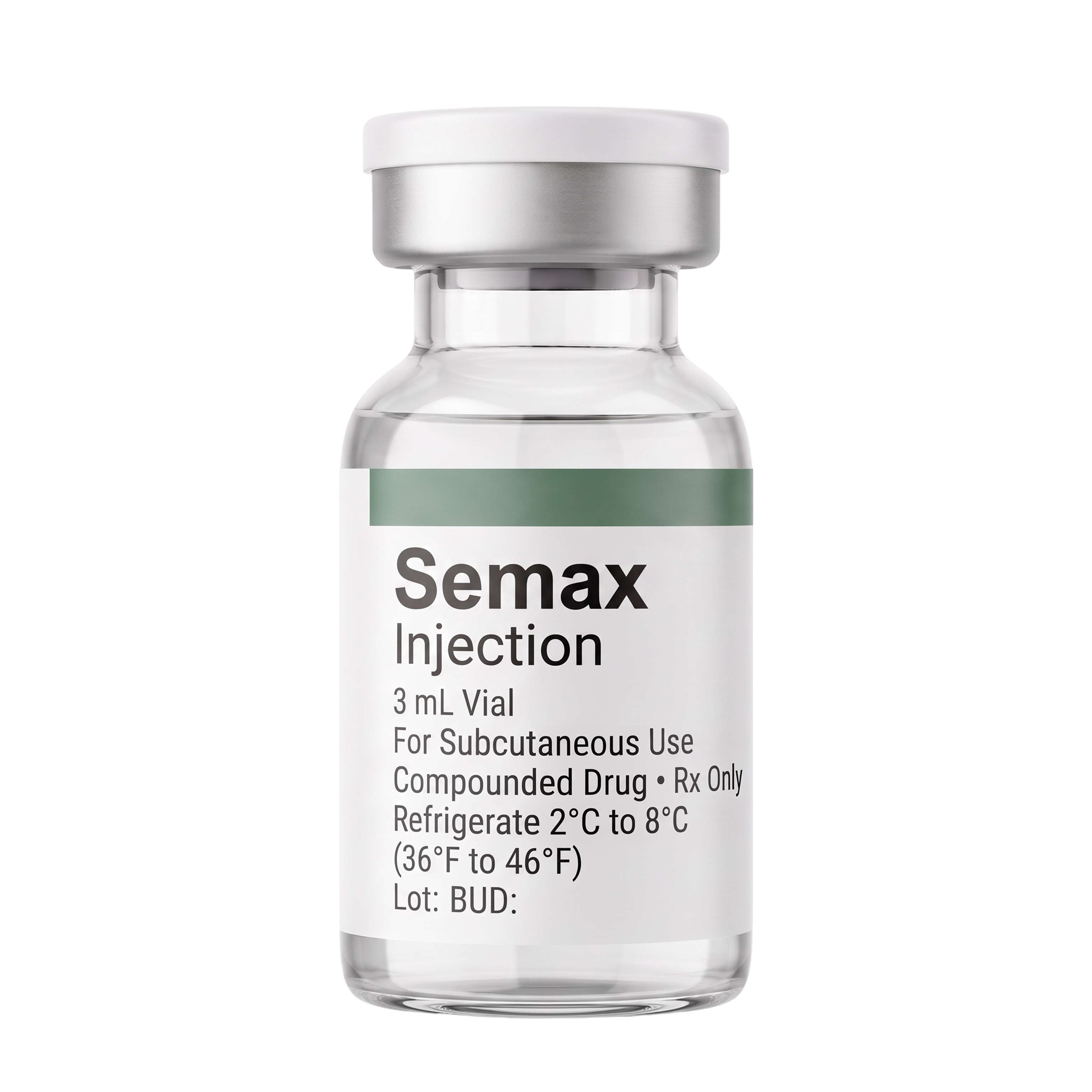
Semax has a following among people interested in focus, memory and brain health, and it gets mentioned in migraine conversations too. Most of what is written about it online skips two important facts: it was developed and studied mainly outside the United States, and it has never been approved by the FDA. This guide covers what Semax is, what the research shows, and what to understand before asking a provider about it.
What Semax is
Semax is a synthetic peptide built from a short fragment of adrenocorticotropic hormone (ACTH), a hormone made by the pituitary gland. Researchers in Russia changed the fragment, adding a short amino acid sequence to help it last longer in the body. The result is a chain of seven amino acids. It does not have the hormonal effects of ACTH itself, such as stimulating the adrenal glands.
What the research shows
Laboratory and animal research has looked at whether Semax affects brain signaling molecules involved in learning and memory, and whether it changes blood flow and the brain’s response to reduced oxygen. In Russia, it has been registered as a medication for certain neurological conditions, and most of the human studies were done there. Those studies tend to be small, and many have not been published in ways that allow independent review.
That is the key point for a patient in the United States. Approval in Russia is not FDA approval, and it does not mean the evidence would meet FDA standards. Semax has not been shown in large, well-controlled trials in the United States to improve memory, focus or migraines, and it is not FDA approved to prevent or treat migraine or any other condition.
Safety questions
Human safety data are limited, and the full side effect profile is not known. Reports include headache, irritation where it is applied or injected, and nausea. One specific caution is bleeding. Semax may increase the risk of bleeding, so tell your provider if you have a bleeding disorder, take blood thinners or antiplatelet medication, or have surgery planned. Pregnant or nursing patients should not use it unless a provider directs otherwise. Long-term safety has not been studied.
Because Semax is promoted heavily online, many people encounter it through unregulated sellers. Products sold that way are not held to pharmacy quality standards, which is a safety issue on its own.
FDA status and compounding
Semax is not an FDA approved drug. A licensed pharmacy can prepare it as a compounded medication for an individual patient with a prescription. Compounded medications are not FDA approved, so the FDA has not evaluated their safety, effectiveness or quality. Rules about which substances may be compounded can change, and your provider and pharmacy follow the requirements in effect at the time.
How DrWell approaches it
A DrWell provider reviews your health history and every medication and supplement you take, with particular attention to anything that affects bleeding, before deciding whether Semax is appropriate. If it is prescribed, it is compounded by a prevetted 503A pharmacy, and your provider explains how to use it and follows up with you. Using a vetted pharmacy improves quality control. It does not make Semax FDA approved and does not establish that it works.